


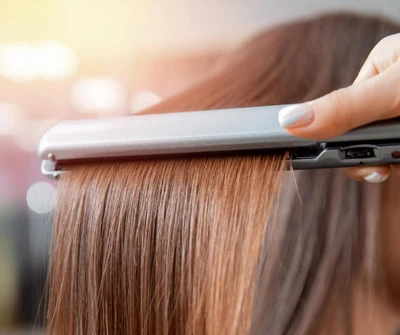
What Temperature Should You Use for a Keratin Treatment? Flat-Iron Temperature Chart by Hair Type
KERATIN TREATMENT on 1st Oct 2026
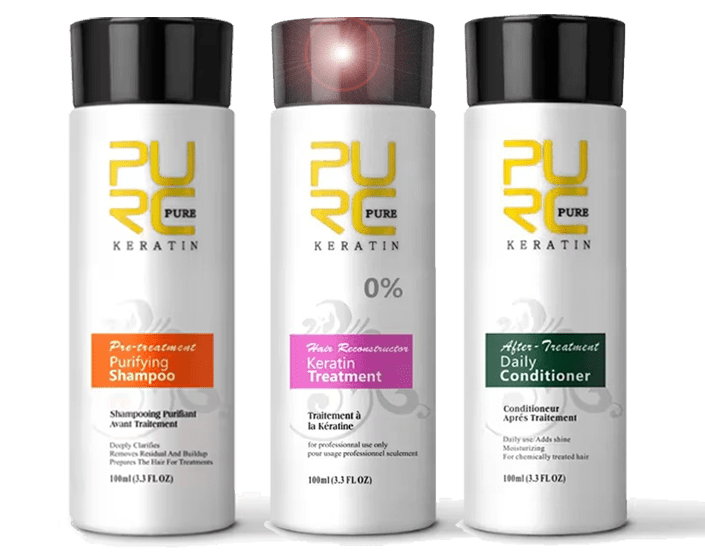
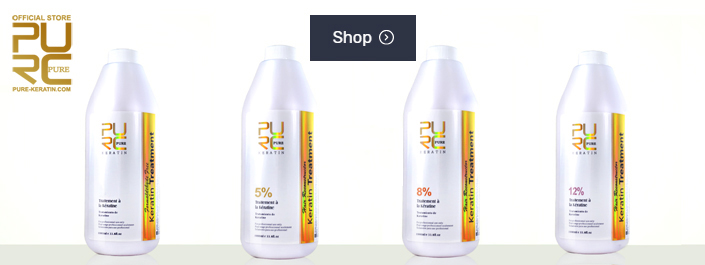
What Temperature Should You Use for a Keratin Treatment? Flat-Iron Temperature Chart by Hair Type
What temperature should you use for a keratin treatment? The correct flat-iron temperature depends on your hair type, hair condition and the specific keratin treatment formula.
As a general guide, keratin treatments may use temperatures ranging from approximately 300°F to 450°F (150°C to 230°C). Fine, fragile, bleached or damaged hair generally requires lower heat, while healthy, thick, coarse or resistant hair may require higher temperatures when permitted by the treatment manufacturer.
Quick answer: Pure Keratin's current application guidance uses 300–400°F (150–200°C) for fine hair and 400–450°F (200–230°C) for thicker hair. Always check the instructions for your exact treatment before choosing a temperature.
Before You Turn Up the Flat Iron
Do not automatically set your flat iron to 450°F (230°C). Higher heat is not appropriate for every hair type.
The best temperature is the one specified for your keratin formula and appropriate for the condition of your hair.
Keratin Treatment Temperature Chart: °F & °C
Use this keratin flat-iron temperature chart as a general planning guide. The instructions supplied with your specific keratin treatment should always take priority.
| Hair Type / Condition | General Temperature Range °F | General Temperature Range °C | Heat Approach |
|---|---|---|---|
| Very fine / fragile hair | 300–350°F | 150–175°C | Use conservative heat |
| Bleached / highlighted / damaged hair | 300–375°F | 150–190°C | Lower heat; assess condition carefully |
| Fine healthy hair | 350–400°F | 175–200°C | Low-to-moderate heat |
| Normal / medium hair | 375–425°F | 190–220°C | Moderate heat |
| Curly healthy hair | 400–430°F | 205–220°C | Adjust for strand thickness and condition |
| Thick / coarse healthy hair | 400–450°F | 200–230°C | Higher heat may be used if product permits |
| Very coarse / resistant healthy hair | 425–450°F | 220–230°C | High heat only when treatment instructions permit |
Important: this chart is not a universal temperature prescription. Different keratin formulations have different application protocols. Always follow the temperature range provided with your specific product.
What Is the Best Temperature for a Keratin Treatment?
There is no single temperature that is best for every keratin treatment and every head of hair.
The appropriate flat-iron temperature depends on three major factors:
- The keratin formula: different treatments can require different sealing temperatures.
- Your hair type: fine strands generally tolerate less heat than thick, coarse strands.
- Your hair condition: bleached, highlighted, fragile or previously damaged hair requires additional caution.
This is why 450°F (230°C) should never be treated as an automatic setting simply because you are performing a keratin treatment.
Pure Keratin's current treatment guidance provides a broad range of 300–400°F (150–200°C) for fine hair and 400–450°F (200–230°C) for thicker hair.
Keratin Treatment Temperature for Fine Hair
For fine hair, Pure Keratin's application guidance allows approximately 300–400°F (150–200°C).
Within that range, the condition of the hair matters. Very fine, fragile or previously compromised hair belongs toward the lower end, while healthy fine hair may tolerate a higher setting if the specific treatment instructions permit it.
A useful general approach is:
- Very fine or fragile: approximately 300–350°F (150–175°C)
- Fine and healthy: approximately 350–400°F (175–200°C)
Do not assume that increasing the temperature will automatically improve the result. Excessive heat can damage the hair's protein structure.
If you have fine hair, you can also explore Pure Keratin's keratin treatment for thin and fine hair.
Keratin Treatment Temperature for Bleached or Damaged Hair
Bleached, highlighted, brittle or damaged hair deserves the most conservative approach to heat.
A general planning range is approximately 300–375°F (150–190°C), but the appropriate setting depends heavily on the condition of the hair and the treatment manufacturer's instructions.
Bleaching and repeated chemical processing can leave hair more vulnerable to additional stress. If the hair shows severe breakage, extreme brittleness or significant existing damage, the more important question may be whether a high-heat smoothing procedure should be performed at all.
When in doubt, have the hair evaluated by an experienced professional stylist before proceeding.
Keratin Treatment Temperature for Normal Hair
For healthy hair of medium thickness, a typical working range may fall around 375–425°F (190–220°C), depending on the treatment.
Normal hair generally does not need to jump immediately to the maximum temperature of the flat iron.
The objective is to use sufficient heat for the treatment protocol while avoiding unnecessary thermal exposure.
Keratin Treatment Temperature for Curly Hair
For healthy curly hair, approximately 400–430°F (205–220°C) may be appropriate for some keratin treatment protocols.
However, curl pattern alone should not determine the temperature.
A person can have curly hair that is fine and fragile or curly hair that is extremely thick and resistant. Those two heads of hair should not automatically receive identical heat.
Consider:
- strand thickness;
- density;
- previous color or bleaching;
- existing heat damage;
- porosity;
- the instructions for the specific keratin formula.
Keratin Treatment Temperature for Thick or Coarse Hair
Pure Keratin's current instructions specify approximately 400–450°F (200–230°C) for thicker hair.
Healthy, thick and coarse hair can be more resistant than fine hair, which is why some professional keratin protocols use higher temperatures for this hair type.
A practical general range is:
- Thick healthy hair: approximately 400–430°F (200–220°C)
- Very coarse or resistant healthy hair: approximately 425–450°F (220–230°C), when specifically permitted by the treatment instructions
Even with thick hair, however, higher is not automatically better. Hair condition still matters.
Should You Use 450°F (230°C) for a Keratin Treatment?
Sometimes—but not automatically.
A temperature around 450°F (230°C) is used in some keratin treatment protocols for healthy, thick, coarse or resistant hair.
However, 450°F is an extremely high styling temperature. It should not be used simply because your flat iron is capable of reaching it.
Research published in the Journal of Cosmetic Science found that hot flat irons operating above 200°C (392°F) can cause significant damage to hair keratin. Other laboratory research examining flat-iron heat has also demonstrated heat-related changes to the hair cuticle and protein structure.
That does not mean that every keratin protocol above 392°F (200°C) automatically damages every person's hair. It does mean that temperature, exposure time, repeated passes, hair condition and product protocol all matter.
Use 450°F (230°C) only when it is appropriate for the hair and specifically compatible with the treatment instructions.
Is 400°F (204°C) Hot Enough for a Keratin Treatment?
It can be. 400°F is approximately 204°C, placing it within the working range of many keratin protocols.
For fine or medium hair, 400°F (204°C) may already represent the upper end of an appropriate range. For very coarse or resistant hair, a particular formula may call for a higher temperature.
The correct answer therefore depends on the treatment rather than simply whether 400°F sounds “hot enough.”
Is 350°F (177°C) Hot Enough for a Keratin Treatment?
For some fine, fragile, bleached or compromised hair, 350°F (177°C) may be an appropriate temperature when allowed by the treatment instructions.
It may be too low for a formula designed to be sealed at substantially higher heat on resistant hair.
This is another reason a universal keratin temperature cannot replace the instructions supplied with the product.
Why Does a Keratin Treatment Need a Flat Iron?
Flat ironing is a key stage in many keratin smoothing protocols. After the treatment is applied, processed and the hair is completely blow-dried, controlled heat is used as part of the smoothing and sealing process.
The exact procedure varies by formulation, which is why temperature, section size and number of passes should be taken from the instructions for the treatment you are using.
For Pure Keratin treatments, current instructions specify that the hair should be completely dry before flat ironing.
Hair Must Be Completely Dry Before Flat Ironing
This point is critical: do not use the keratin-treatment flat-ironing step on wet hair unless a specific professional protocol explicitly tells you otherwise.
Pure Keratin's current application instructions call for the hair to be 100% dry before flat ironing.
Follow the drying and processing sequence provided with your specific treatment rather than improvising the application procedure.
How Many Flat-Iron Passes Do You Need for a Keratin Treatment?
Temperature is only one part of heat exposure. The number of passes matters too.
Pure Keratin's current application instructions call for working in approximately ½-inch sections and flat ironing each section 7–10 times during the sealing stage.
However, you should not automatically combine the highest possible temperature with the maximum possible number of passes.
Consider total heat exposure as a combination of:
- flat-iron temperature;
- number of passes;
- speed of each pass;
- section thickness;
- hair condition;
- treatment formulation.
Follow the pass count and heat setting specified for your treatment.
Does a Higher Flat-Iron Temperature Make Keratin Last Longer?
Not necessarily. Using more heat than required is not a reliable shortcut to longer-lasting results.
The treatment needs to be performed according to its intended application protocol. Increasing the temperature beyond what is appropriate can increase thermal stress without guaranteeing a better result.
Long-lasting results also depend on factors after the application, including your washing routine, shampoo choice, swimming, styling habits and general aftercare.
What Happens If the Flat Iron Is Too Hot?
If the temperature is too high for the hair's condition, excessive thermal exposure can contribute to:
- dryness;
- brittleness;
- cuticle damage;
- protein degradation;
- breakage;
- loss of elasticity;
- damaged or rough-feeling ends.
Scientific studies examining flat-iron heat have found measurable changes to hair proteins and the hair cuticle following high-temperature exposure.
This is why the correct question is not “What is the hottest temperature I can use?” but rather “What temperature does this treatment require for this hair?”
What Happens If the Flat Iron Temperature Is Too Low?
Using substantially less heat than a treatment protocol requires may prevent the application from performing as intended.
Possible consequences can include:
- less effective smoothing;
- uneven results;
- shorter-lasting results;
- sections that respond differently;
- the temptation to compensate with excessive repeated passes.
Do not lower the temperature arbitrarily. Instead, choose a treatment compatible with your hair type and follow its instructions.
Temperature vs. Number of Passes: Which Matters More?
Both matter because both contribute to total thermal exposure.
For example, one pass at a given temperature is not equivalent to repeatedly passing a hot iron over the same section.
This is particularly important for fine, bleached or damaged hair. A conservative temperature combined with controlled passes may be more appropriate than repeatedly exposing vulnerable hair to extreme heat.
The manufacturer's instructions should specify the intended balance between temperature and passes.
Should You Use Titanium or Ceramic Flat Irons for Keratin Treatments?
The most important feature is reliable, adjustable temperature control.
Your flat iron should be capable of reaching the temperature required by your specific treatment and maintaining it consistently.
A tool with adjustable digital temperature control makes it easier to avoid treating every hair type at the same maximum setting.
For professional keratin work, accurate temperature selection is more useful than simply choosing the hottest flat iron available.
Keratin Flat-Iron Temperature: Celsius to Fahrenheit Conversion
For readers in the United States, Canada, UK, Australia, Europe and elsewhere, here is a quick conversion chart for common keratin-treatment temperatures:
| Fahrenheit | Celsius | Typical Context |
|---|---|---|
| 300°F | 149°C | Very low end of some fine-hair protocols |
| 325°F | 163°C | Fine / fragile range |
| 350°F | 177°C | Fine / conservative heat |
| 375°F | 191°C | Fine-to-normal range |
| 400°F | 204°C | Normal / medium-to-thick range depending on formula |
| 410°F | 210°C | Medium / thicker hair range in some protocols |
| 425°F | 218°C | Thick / coarse healthy hair range |
| 430°F | 221°C | Thick / resistant range |
| 450°F | 232°C | Maximum used by some protocols for resistant hair |
Can You Use the Same Temperature on the Roots and Ends?
Not always. Hair condition can vary significantly along the same strand.
For example, newer growth near the roots may be relatively healthy while the mid-lengths and ends have years of accumulated coloring, bleaching, sun exposure and heat styling.
That means the ends may be considerably more fragile than the roots.
A professional stylist can evaluate these differences and determine whether the hair can safely tolerate the treatment protocol.
What Temperature Should You Use on Colored Hair?
Colored hair should be evaluated according to both strand thickness and chemical history.
Healthy hair with deposited color is not necessarily equivalent to heavily bleached or repeatedly highlighted hair.
For chemically compromised hair, a conservative heat approach is generally preferable. Always check whether your keratin treatment has specific instructions for colored, blonde, highlighted or bleached hair.
What Temperature Should You Use on Blonde Hair?
Blonde hair requires a more nuanced answer because natural blonde hair and bleached blonde hair are not the same thing.
Natural, healthy blonde hair should be assessed primarily by strand thickness and condition. Bleached blonde hair has undergone chemical processing and may require substantially more caution.
For bleached or fragile blonde hair, a general planning range around 300–375°F (150–190°C) may be appropriate for compatible treatments, but the product instructions must determine the actual setting.
What Temperature Should You Use on Afro-Textured Hair?
Do not choose the flat-iron temperature from curl pattern or ethnicity alone.
Afro-textured hair can be fine, medium or coarse; natural or chemically processed; healthy or damaged. Each of these factors can change the appropriate heat setting.
Healthy, coarse, resistant hair may fall toward a higher treatment range, while fine, bleached, relaxed or compromised hair requires a more conservative approach.
The safest approach is to match the treatment formula + strand thickness + current condition, rather than assuming all highly textured hair needs maximum heat.
Keratin Treatment Heat Safety
Heat deserves particular attention during a keratin smoothing service.
Laboratory research has demonstrated that high-temperature flat ironing can alter hair keratin and damage the cuticle. Temperature control therefore matters both for achieving the intended treatment result and for limiting unnecessary thermal stress.
There is another reason to read the product label carefully: some hair-smoothing products can contain or release formaldehyde or related substances during heating.
The U.S. Occupational Safety and Health Administration (OSHA) advises salons to identify chemical hazards in smoothing products and notes that heat during blow-drying or flat ironing can contribute to chemical release from certain formulations.
For additional information, see OSHA's guidance on hair-smoothing products and salon safety.
How to Choose the Correct Keratin Temperature: 5-Step Checklist
1. Read the Treatment Instructions First
Before turning on the flat iron, find the manufacturer's recommended temperature range for the exact formula you are using.
2. Identify Your Strand Thickness
Determine whether your individual strands are fine, medium or coarse. Do not confuse hair density with strand thickness.
3. Assess Chemical History
Bleaching, highlighting, relaxing and repeated chemical services can change how conservatively you should approach heat.
4. Examine the Ends
The ends may be significantly more fragile than newer hair near the roots.
5. Do Not Automatically Select Maximum Heat
If your iron reaches 450°F (230°C), that does not mean every keratin treatment or every hair type should be processed at 450°F.
Choose a Keratin Treatment for Your Hair Type
The correct result starts with choosing an appropriate formula—not simply increasing the flat-iron temperature.
Frequently Asked Questions About Keratin Treatment Temperature
What temperature should I use for a keratin treatment?
Keratin-treatment temperatures can range approximately from 300°F to 450°F (150°C to 230°C), depending on the formula, hair type and hair condition. Fine, fragile or damaged hair generally requires less heat than healthy, thick or coarse hair. Always follow the instructions supplied with your specific treatment.
What temperature does Pure Keratin recommend?
Pure Keratin's current application guidance specifies approximately 300–400°F (150–200°C) for fine hair and 400–450°F (200–230°C) for thicker hair. The exact setting should be selected according to the hair condition and instructions for the treatment being used.
What temperature should I use for keratin on fine hair?
Pure Keratin's general fine-hair range is 300–400°F (150–200°C). Very fine or fragile hair should stay toward the more conservative end of an appropriate product-specific range.
What temperature should I use for keratin on damaged hair?
Damaged, fragile, bleached or heavily processed hair generally requires lower heat. Approximately 300–375°F (150–190°C) can be used as a general planning range for compatible formulas, but severely compromised hair should be professionally evaluated before a high-heat smoothing procedure.
What temperature should I use for keratin on thick hair?
Pure Keratin's instructions specify approximately 400–450°F (200–230°C) for thicker hair. Use the higher end only when the hair is healthy and resistant and the specific treatment instructions permit that temperature.
What temperature should I use for keratin on curly hair?
Healthy curly hair may fall around 400–430°F (205–220°C) in some protocols, but curl pattern alone should not determine the setting. Fine or damaged curls may require considerably lower heat.
What temperature should I use for keratin on bleached hair?
Bleached hair should generally be treated more conservatively. A general range of approximately 300–375°F (150–190°C) may be appropriate for compatible formulas, but always follow product-specific instructions and consider the degree of existing damage.
Is 450°F (230°C) too hot for keratin?
450°F (230°C) is a very high temperature. Some keratin protocols use it for healthy, coarse or resistant hair, but it should not be used automatically on fine, bleached, fragile or damaged hair. Use it only when appropriate for the hair and permitted by the treatment instructions.
Is 400°F (204°C) enough for a keratin treatment?
Yes, 400°F (204°C) falls within the working range of many keratin-treatment protocols. Whether it is the correct temperature depends on the specific treatment and hair condition.
Is 350°F (177°C) enough for a keratin treatment?
350°F (177°C) may be suitable for some fine, fragile or chemically processed hair when the treatment instructions permit that temperature. Other formulas and resistant hair types may require more heat.
How many times should I pass the flat iron during a keratin treatment?
Pure Keratin's current application instructions specify approximately 7–10 passes over ½-inch sections. Other treatments may use different instructions, so always follow the protocol for your specific product.
Should hair be completely dry before flat ironing a keratin treatment?
For Pure Keratin's current treatment protocol, yes—the hair should be 100% dry before the flat-ironing stage. Follow the drying instructions supplied with your specific treatment.
Does hotter mean better for a keratin treatment?
No. More heat does not automatically produce a better or longer-lasting result. Excessive temperature can increase thermal stress and hair damage. Use the temperature required by the treatment and appropriate for the condition of the hair.
Final Answer: What Flat-Iron Temperature Should You Use for Keratin?
If you need a quick reference, these are useful general planning ranges:
- Very fine / fragile hair: 300–350°F (150–175°C)
- Bleached / damaged hair: 300–375°F (150–190°C)
- Fine healthy hair: 350–400°F (175–200°C)
- Normal / medium hair: 375–425°F (190–220°C)
- Curly healthy hair: 400–430°F (205–220°C)
- Thick / coarse healthy hair: 400–450°F (200–230°C)
- Very coarse / resistant healthy hair: 425–450°F (220–230°C), when permitted by the treatment instructions
But remember the most important rule: your keratin treatment's instructions take priority over any generic temperature chart.
Pure Keratin's current general application guidance specifies 300–400°F (150–200°C) for fine hair and 400–450°F (200–230°C) for thicker hair.
Choose the temperature according to the formula, strand thickness and current condition of the hair rather than automatically setting the flat iron to its maximum temperature.
Get Better Keratin Results by Starting With the Right Treatment
Temperature is only one part of a successful keratin treatment. The formula should also match your hair type and condition.
Shop Pure Keratin Treatments →
Have fine or thin hair?