


Keratin Treatment and Hair Extensions: Is It Safe?
KERATIN TREATMENT on 14th Sep 2026
Keratin Treatment and Hair Extensions: Is It Safe?
Yes, a keratin smoothing treatment can sometimes be combined with hair extensions, but the safest method depends on the type of extensions you wear. The biggest risks are getting smoothing solution onto adhesive or keratin bonds, applying excessive heat close to attachment points, and treating extension hair that was never designed to undergo another chemical service.
In many cases, the best approach is to perform the keratin treatment on your natural hair before installing or reinstalling the extensions. That gives the stylist unrestricted access to your natural hair and avoids exposing tapes, capsules, bonds, rings, or stitching points to treatment product and sealing heat.
If extensions are already installed, treatment may still be possible in some situations, but the stylist needs to work carefully around every attachment point.
Quick Answer: Can You Get a Keratin Treatment With Hair Extensions?
- Yes, sometimes. Keratin and hair extensions are not automatically incompatible.
- Keratin before extension installation is usually the easiest option.
- Tape-in extensions require particular caution because smoothing products, oils, residue and heat may affect the adhesive.
- Keratin-bond or fusion extensions require product and heat to stay away from the bonds.
- Micro-ring and nano-ring extensions avoid adhesive, but excessive heat still should not be concentrated around attachment points.
- Wefts and sew-ins require careful sectioning around tracks and stitching.
- Clip-ins are best removed before treatment.
- Do not assume extension hair itself should be treated simply because your natural hair needs smoothing.
The simplest rule: smooth the natural hair while protecting—or temporarily removing—the extension attachment system.
Why Keratin Treatments and Extensions Need Special Care
A smoothing treatment and a hair extension installation are two different services with different chemical and mechanical requirements.
A keratin treatment typically involves:
- A cleansing or preparation step.
- Application of smoothing solution.
- Blow-drying.
- Heat sealing with a flat iron.
Hair extensions, meanwhile, can be attached using:
- Adhesive tape.
- Keratin or polymer bonds.
- Micro rings.
- Nano rings.
- Sewn wefts.
- Beaded rows.
- Temporary clips.
The risk occurs when the smoothing formula, preparation shampoo, repeated washing, or flat-iron heat interferes with the extension attachment method.
Is It Better to Get Keratin Before or After Hair Extensions?
Whenever practical, getting the keratin treatment before a new extension installation is usually the cleaner and more predictable sequence.
With the extensions removed, the stylist can:
- Reach all of your natural hair evenly.
- Apply the treatment without working around attachment points.
- Control flat-iron heat more precisely.
- Avoid contaminating extension adhesives or bonds.
- Smooth the roots and underneath sections properly.
- Evaluate the condition of your natural hair before reinstalling extensions.
Hair Xpressions Salon similarly recommends considering the smoothing service around an extension move-up or new installation because the natural hair can be treated more thoroughly while the attachment areas are accessible.
Can You Do Keratin With Tape-In Extensions?
Tape-ins are one of the extension methods that require the most caution around keratin treatments.
Tape extensions depend on adhesive strips gripping clean hair. Smoothing solution, oils, conditioners, treatment residue, or excessive heat around those strips may interfere with adhesion.
If tape-ins are already installed:
- Do not saturate the tape tabs with keratin treatment.
- Avoid applying heavy products directly over the adhesive.
- Do not clamp a very hot flat iron over the tape attachment.
- Avoid aggressive pulling while sectioning.
- Follow the extension manufacturer's care instructions.
If you are already due for a tape move-up, the better strategy may be to remove the extensions, perform the smoothing service on your natural hair, and reinstall the tapes according to the extension system's preparation requirements.
Can Keratin Make Tape Extensions Slip?
Potentially, yes. Anything that compromises the adhesive interface can increase the risk of slipping.
This is why a smoothing treatment should not be applied casually over the tape tabs.
Can You Get Keratin With Keratin-Bond or Fusion Extensions?
Yes, in some cases—but the terminology can be confusing.
The "keratin" in a smoothing treatment and the "keratin bond" used in extensions are not the same service.
Fusion or keratin-bond extensions use small attachment points that secure extension strands to the natural hair. These bonds can be sensitive to concentrated heat and certain products.
When smoothing hair around fusion extensions:
- Keep the smoothing solution away from the capsules unless the extension manufacturer specifically permits contact.
- Do not clamp the flat iron directly over the bonds.
- Work in controlled sections.
- Keep excessive oils or conditioners away from the attachment points.
- Let someone experienced with both services perform the treatment.
Extension professionals specifically warn that smoothing solution and flat-iron heat can soften or compromise capsule attachment points when applied directly to them.
Will a Keratin Treatment Melt Keratin Extension Bonds?
The treatment itself does not automatically melt every bond, but excessive flat-iron heat applied directly to a fusion capsule can soften or damage the attachment.
That creates the potential for:
- Premature slipping.
- Weakened bonds.
- Extension shedding.
- Sticky or distorted capsules.
- Difficulty during later removal.
The attachment zone should therefore be treated as a heat-sensitive area.
Can You Do Keratin With Micro-Ring or Nano-Ring Extensions?
Micro-ring and nano-ring extensions may be easier to work around than adhesive extensions because they do not rely on tape glue.
However, that does not mean the attachments should be ignored.
The stylist should:
- Avoid excessive product buildup around the rings.
- Keep the flat iron from clamping directly onto metal attachment points.
- Avoid excessive tension while sectioning.
- Work carefully where the natural hair enters each ring.
Metal rings can become hot if direct heat is repeatedly applied, so the flat iron should be controlled carefully.
What About Sew-In, Weft or Beaded-Row Extensions?
Keratin treatment may be possible around weft extensions, but access becomes more difficult because the hair is divided by rows or tracks.
Potential problems include:
- Missing sections of natural hair close to the track.
- Product accumulating around stitching or beads.
- Difficulty rinsing or drying underneath the weft.
- Heat being applied too close to beads or attachment points.
If the wefts are already due for maintenance, treating the natural hair while they are removed may give a more uniform result.
Can You Keratin-Treat Clip-In Hair Extensions?
Remove clip-in extensions before performing a keratin treatment on your natural hair.
There is no reason to keep temporary extensions installed during a smoothing service.
If you are considering applying keratin directly to the clip-in hair itself, first determine:
- Whether the extensions are human or synthetic hair.
- Whether the manufacturer allows chemical treatments.
- Whether they have already been color-treated or coated.
- What heat temperature the extension hair can tolerate.
Can You Apply Keratin Treatment Directly to Hair Extensions?
Not automatically.
High-quality human hair extensions can sometimes tolerate controlled professional smoothing, but extension hair behaves differently from hair growing from the scalp.
Extension hair:
- No longer receives natural scalp oils.
- May already have undergone color processing.
- May have been chemically altered during manufacturing.
- May have silicone or cosmetic coatings.
- Can become dry more quickly after repeated heat exposure.
A treatment that improves your natural hair could potentially leave extension hair dry, change its texture, alter its color, or shorten its usable life.
Always strand-test extension hair before treating the full length.
Human Hair vs Synthetic Extensions: Can Both Have Keratin?
| Extension Type | Keratin Smoothing Treatment? |
|---|---|
| Virgin human hair extensions | Possibly, after strand testing and manufacturer approval |
| Color-treated human hair extensions | Use additional caution because hair may already be processed |
| Bleached blonde extensions | Higher risk of dryness, color change and heat damage |
| Synthetic extensions | Generally not suitable unless specifically rated for the process |
Synthetic fibers can distort, melt, or permanently change under flat-iron temperatures used for many smoothing treatments. Never assume synthetic hair can tolerate the same temperature as human hair.
Hair Extension Compatibility Guide
| Extension Method | Keratin Compatibility | Main Risk | Preferred Approach |
|---|---|---|---|
| Tape-ins | Possible with significant caution | Adhesive slipping or weakening | Ideally treat natural hair during removal/move-up |
| Keratin/fusion bonds | Possible | Heat or product compromising capsules | Keep treatment and iron off bonds |
| Micro rings | Possible | Heat transfer and buildup near rings | Work carefully around attachments |
| Nano rings | Possible | Heat and tension at attachment points | Avoid direct iron contact |
| Sew-in/weft | Possible | Uneven application or residue around tracks | Prefer treatment during maintenance if practical |
| Clip-ins | Remove for treatment | Unnecessary heat/chemical exposure | Treat natural hair separately |
| Synthetic extensions | Usually unsuitable | Heat deformation or melting | Check manufacturer specifications |
Can Keratin Damage Hair Extensions?
Yes, if the extension hair is overprocessed.
Potential signs include:
- Dryness.
- Tangling.
- Matting.
- Brittleness.
- Loss of curl or wave pattern.
- Color changes.
- Split or frayed ends.
- Reduced extension lifespan.
Remember that extensions cannot repair themselves and do not receive sebum from the scalp the way natural hair does. Once extension lengths become severely dry or damaged, the realistic solution may be replacement rather than repeated chemical correction.
Should You Remove Extensions Before a Keratin Treatment?
If your extensions are already due for maintenance, removal before keratin is often the most practical option.
This is particularly useful for:
- Tape-ins that need a move-up.
- Wefts ready for repositioning.
- Extensions with significant regrowth.
- Natural roots that need thorough smoothing.
- Clients whose natural texture is very different from the extension texture.
The stylist can treat the natural hair completely and then reinstall the extensions after completing the smoothing protocol and any required preparation for the extension adhesive or attachment system.
How Long Should You Wait Between Keratin and Extension Installation?
There is no one waiting period that applies to every keratin formula and extension brand.
Traditional smoothing treatments may have a period during which the hair should not be washed or manipulated, while other formulas permit washing much sooner.
Tape extensions may also require the hair to be clean and free of products that could interfere with adhesive.
For that reason, schedule the installation only after:
- The keratin treatment's required setting period is complete.
- Any required first wash has been performed.
- The hair meets the extension manufacturer's installation requirements.
- Your stylist confirms that no treatment residue will interfere with the attachment method.
Avoid relying on a universal "24-hour," "48-hour," or "72-hour" rule unless that timing matches the exact products being used.
Should Extensions Match Your Natural Hair Before Keratin?
Yes. Texture matching is important.
If your natural hair is curly or very frizzy but your extensions are straight, smoothing the natural hair can make blending easier.
However, if your extension hair already matches your desired texture, there may be little benefit in chemically treating the extensions themselves.
Hair Xpressions notes that when extension lengths are already straight and smooth, the natural hair is often the section that actually needs treatment.
What Temperature Should Be Used Around Extensions?
There is no universal temperature for every combination of smoothing treatment and extension hair.
The correct temperature depends on:
- The keratin treatment manufacturer's instructions.
- Your natural hair's texture and condition.
- The extension hair's quality and processing history.
- The extension attachment system.
The most important heat rule is simple:
Do not clamp the flat iron directly over tapes, fusion capsules, rings, beads, or other attachment points.
Extension hair should also be tested before using high temperatures because bleached, processed, or lower-quality hair may react very differently from healthy natural hair.
Can You Do a Keratin Treatment at Home With Extensions Installed?
It is substantially more complicated than treating hair without extensions.
At-home application makes it harder to see attachment points at the back of your head and maintain a consistent safety distance from tapes, bonds, rings, or tracks.
Common mistakes include:
- Coating extension bonds with smoothing solution.
- Running the flat iron over attachment points.
- Applying excessive heat to processed extension hair.
- Missing areas of natural hair hidden under extensions.
- Applying too much product near the roots.
If you already wear permanent or semi-permanent extensions, professional application by someone who understands both keratin smoothing and your specific extension system is the safer approach.
Can I Use Pure Keratin Treatments If I Wear Extensions?
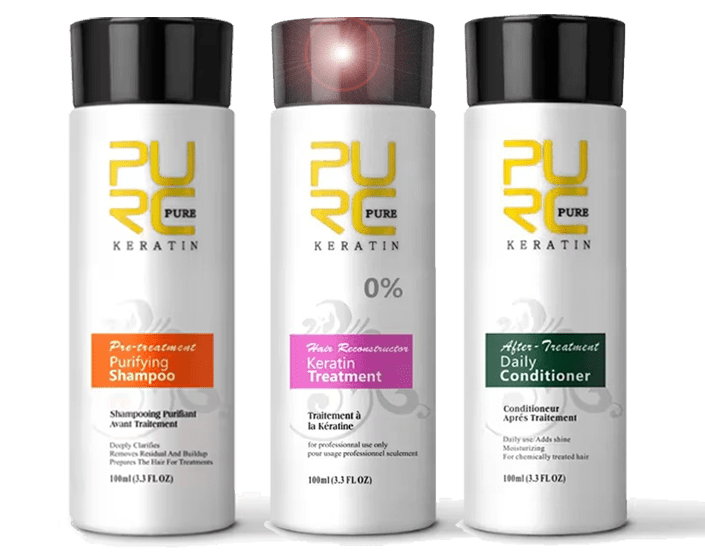
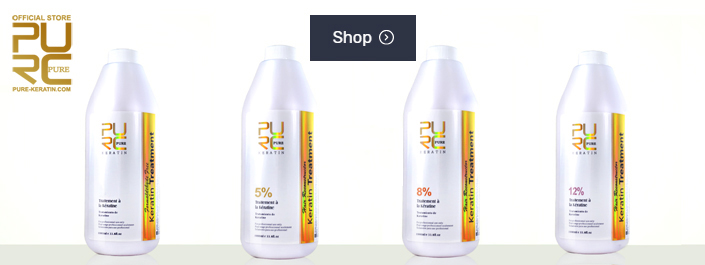
Pure-Keratin.com offers professional smoothing systems for different hair types as well as shampoos, conditioners, masks and aftercare products.
If extensions are installed, select the treatment according to your natural hair type and condition and follow the exact product instructions rather than treating the extension attachments as ordinary hair.
Explore:
- Pure Keratin professional keratin treatments.
- 200+ Pure Keratin hair-care products.
- After Keratin Treatment Daily Shampoo for ongoing maintenance.
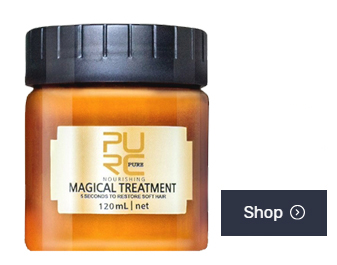
- Pure Keratin Hair Masks for conditioning dry lengths.
Pure-Keratin.com brings more than 30 years of hair-care experience to professional smoothing and maintenance, with options designed for different textures, conditions and treatment goals.
How to Care for Extensions After a Keratin Treatment
1. Follow the Keratin Treatment's First-Wash Instructions
Some formulas require a setting period; others allow washing sooner. Follow the directions for the treatment you actually used.
2. Keep Conditioner Away From Extension Bonds
Condition the extension lengths, but do not saturate adhesive tapes or fusion attachment points with heavy conditioner unless the extension manufacturer specifically allows it.
3. Detangle Carefully
Support the hair near the attachment points and brush gently from the ends upward.
4. Dry the Attachment Areas Properly
Do not leave the roots, tracks or bonds wet for long periods after washing.
5. Avoid Unnecessary High Heat
Keratin treatments often reduce the amount of heat styling required, which can be an advantage for extension longevity.
6. Use Gentle Maintenance Products
Use hair-care products that are appropriate for your keratin treatment and compatible with your extension system.
Can You Use Oil on Keratin-Treated Hair Extensions?
Hair oil can help improve the feel and appearance of dry extension lengths, but placement matters.
Apply lightweight oil primarily to the mid-lengths and ends rather than saturating:
- Tape adhesive.
- Fusion bonds.
- Keratin capsules.
- Micro-ring attachment areas.
Too much oil around certain extension attachments can encourage slipping or buildup.
What If My Extensions Start Slipping After Keratin?
If you notice multiple extensions slipping shortly after treatment:
- Do not attempt to glue or rebond them yourself.
- Contact your extension stylist.
- Explain which smoothing treatment and aftercare products were used.
- Avoid pulling on loose attachments.
- Have the remaining bonds or tapes checked.
Repeated slipping can indicate that product, oil, conditioner, or heat compromised the attachment area.
Keratin Treatment Before Extensions: Ideal Appointment Sequence
When starting from scratch, a practical sequence is:
- Consult about your natural hair, desired extension type and smoothing goals.
- Perform the keratin treatment on the natural hair.
- Complete the treatment's required setting and washing protocol.
- Prepare the hair according to the extension manufacturer's directions.
- Install extensions on clean, properly prepared hair.
- Blend the natural hair and extensions without overheating attachment points.
- Follow a maintenance routine compatible with both services.
When Should You Avoid Combining Keratin and Extensions?
Postpone or reconsider the combination if:
- Your natural hair is breaking or severely overprocessed.
- Your extensions are already slipping or damaged.
- The attachment points are tangled or matted.
- Your scalp is inflamed, irritated, or injured.
- The extension manufacturer prohibits chemical smoothing.
- The extension hair cannot tolerate the required heat.
- You cannot safely keep treatment and heat away from the attachments.
Adding one service on top of another should never take priority over protecting weakened natural hair.
People Also Ask About Keratin Treatments and Hair Extensions
Can I get a keratin treatment if I have hair extensions?
- Yes, in many cases.
- The correct technique depends on your extension attachment method.
- Smoothing product and direct flat-iron heat should generally be kept away from attachment points.
- When possible, treating natural hair during an extension removal or move-up is often easier.
Can keratin treatment loosen hair extensions?
- It can if treatment products or oils interfere with tape adhesive.
- Excessive heat can also compromise some fusion or keratin bonds.
- A specialist should protect attachment points throughout the service.
Can I do keratin with tape-in extensions?
- It may be possible, but tape adhesive requires extra caution.
- Avoid treatment product, conditioners, oils and direct flat-iron heat on the tape tabs.
- If you are due for a move-up, treating the natural hair with the tapes removed may be preferable.
Can I get keratin with fusion extensions?
- Yes, potentially.
- Keep smoothing product and flat-iron heat off the fusion capsules.
- Do not clamp a hot iron directly over keratin bonds.
Should I get keratin before or after extensions?
- Before installation is often easier and more uniform.
- The stylist can treat all of your natural hair without working around attachment points.
- Install extensions only once the smoothing protocol and extension preparation requirements are complete.
Can you put keratin treatment on human hair extensions?
- Sometimes, but not every extension should be chemically treated.
- Extension hair may already be color-treated or chemically processed.
- Perform a strand test and check the extension manufacturer's recommendations first.
Can you put keratin treatment on synthetic hair extensions?
- Usually not.
- Synthetic fibers may not tolerate the heat required for smoothing treatments.
- Follow the manufacturer's heat and chemical-treatment limits.
Will keratin melt extension bonds?
- The smoothing treatment does not automatically melt bonds.
- However, direct high heat can soften or damage some fusion attachment points.
- Keep the flat iron away from bonds and capsules.
Can I use a flat iron on extensions after keratin?
- Yes, if the extension hair is heat-safe.
- Use heat protectant and the lowest effective temperature.
- Never clamp the iron directly onto tapes, bonds, rings, beads or clips.
Keratin Treatment + Extension Safety Checklist
- Identify exactly which extension method you have.
- Check whether the extension manufacturer permits chemical smoothing.
- Decide whether the treatment can be scheduled during your next move-up.
- Protect every tape, bond, ring, bead and track.
- Do not apply direct flat-iron heat to attachment points.
- Strand-test extension hair before chemically treating it.
- Use conservative heat on processed extension lengths.
- Follow the keratin formula's instructions.
- Follow the extension brand's maintenance instructions.
- Prioritize your natural hair's condition over achieving perfectly straight extensions.
Final Verdict: Keratin and Hair Extensions Can Work Together—But Technique Matters
You do not necessarily have to choose between smooth, frizz-controlled hair and extensions. Keratin treatments can often coexist with tape-ins, fusion bonds, rings, wefts and other extension systems when the service is planned correctly.
The safest approach is usually to smooth your natural hair before a new extension installation or during a scheduled move-up. If the extensions remain installed, the treatment should be carefully sectioned around the attachment points, with both the smoothing product and flat-iron heat kept away from vulnerable tapes, capsules, rings and bonds.
Just as importantly, do not automatically treat the extension hair itself. Human hair extensions may already have undergone significant processing, while synthetic extensions may not tolerate smoothing-treatment temperatures at all.
When treatment selection, extension method and aftercare are considered together, you can preserve both the smooth result and the longevity of your extensions.
Explore professional smoothing formulas, maintenance shampoos, conditioners and masks from Pure-Keratin.com, with more than 200 hair-care products and over 30 years of experience in professional keratin hair care.
Sources and Further Reading