


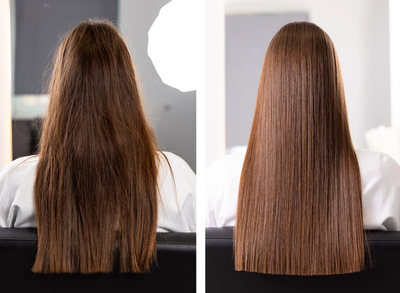
Cut Hair Before or After Keratin Treatment? Best Order Explained
PURE KERATIN on 5th Oct 2026
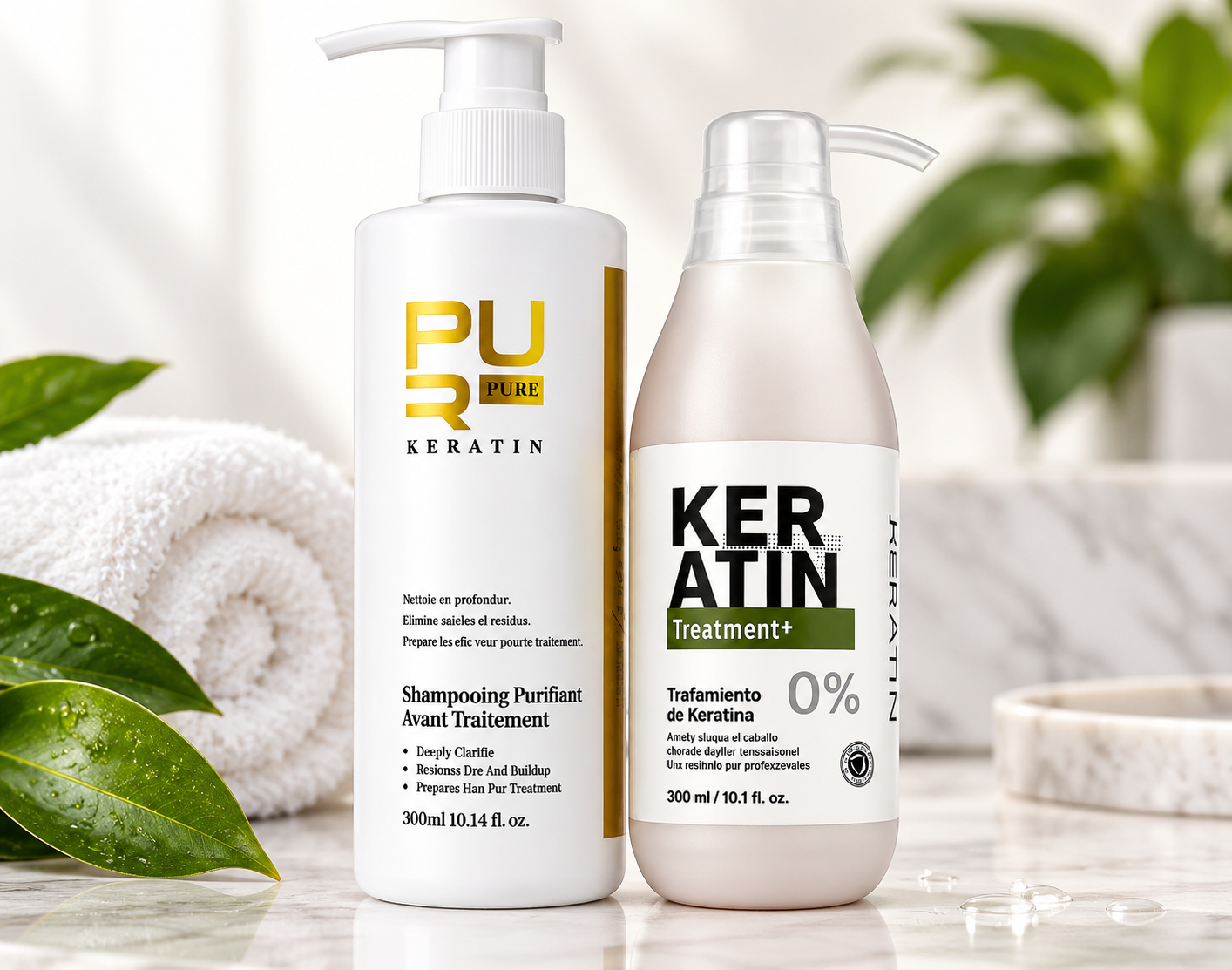
Should You Cut Your Hair Before or After a Keratin Treatment? The Best Order for a Smooth Finish
Should you cut your hair before or after a keratin treatment? In most cases, it makes sense to do the keratin treatment first and the final haircut afterward. This allows the stylist to see how your hair falls once it is smoother, less frizzy and easier to manage, then shape the finished result more precisely.
There is one important exception: if your ends are severely split, broken or damaged, removing some of that compromised hair before treatment can make sense. The final shaping and detailing can still be performed afterward.
Quick answer: for most people, the preferred order is:
- Keratin treatment
- Haircut or final trim
- Keratin aftercare
If the ends are badly damaged, consider a preliminary trim first, followed by the keratin treatment and then the final shaping.
Planning a Smoother, More Manageable Finish?
Start with a professional keratin treatment selected for your hair type, then shape the finished result with the haircut that suits your smoother texture.
Haircut Before or After Keratin Treatment? Quick Guide
| Situation | Cut Before or After Keratin? | Why? |
|---|---|---|
| Regular haircut | After | Allows the stylist to shape the hair in its smoother finished state |
| Small maintenance trim | Usually after | Helps create a clean final perimeter |
| Long layers | After | Layers can be positioned according to the hair's post-treatment movement and volume |
| Bangs / fringe | Usually after | Smoother hair may sit differently around the face |
| Major restyle | Usually after | The stylist can design the new shape around the finished texture |
| Severely split or damaged ends | Trim before, finish after | Remove badly compromised ends first, then refine the shape after treatment |
| Same-day salon appointment | Keratin first, final cut after | The stylist can see the final fall of the treated hair before detailing the cut |
Important: the exact order can vary according to the treatment, haircut technique and condition of your hair. If your stylist has a specific technical reason for changing the sequence, follow their professional recommendation.
Why Is It Usually Better to Cut Hair After a Keratin Treatment?
The main advantage of cutting afterward is simple: a keratin treatment can change the way your hair looks, falls and moves.
Before treatment, frizz, curl, waves and volume can influence the apparent shape of the haircut. After smoothing, the hair may hang differently.
Cutting after the treatment allows the stylist to work with the finished texture rather than trying to predict exactly how the untreated hair will behave afterward.
This can be especially useful when creating:
- clean ends;
- face-framing pieces;
- long layers;
- precise bangs or fringe;
- a smooth blunt cut;
- balanced movement through long hair.
Does Keratin Treatment Change the Way Your Haircut Looks?
It can.
A keratin smoothing treatment can reduce frizz, make hair more manageable and change how much volume or curl is visible. Depending on your original texture and the treatment used, the hair may appear smoother, straighter or more elongated afterward.
This means a haircut that looks balanced before treatment may look somewhat different once the hair has been smoothed.
For example, curly or wavy hair can appear longer after smoothing because the strand is no longer contracting into the same curl or wave pattern.
That is one of the strongest reasons to perform detailed cutting after the treatment.
Should You Trim Split Ends Before a Keratin Treatment?
This is the main exception to the “keratin first, haircut second” approach.
If your hair has severely split, thin, broken or compromised ends, removing some of the damaged length before the treatment can be beneficial from a haircut-planning perspective.
A keratin treatment can improve smoothness and manageability, but it does not permanently repair a split end back into an intact strand.
Once the end of a hair fiber has physically split, trimming is the reliable way to remove that damaged portion.
A useful order for heavily damaged ends can therefore be:
- Remove the worst split or broken ends.
- Perform the keratin treatment if the remaining hair is suitable for it.
- Complete the final haircut and detailing afterward.
Can Keratin Treatment Fix Split Ends?
Keratin treatment should not be considered a substitute for cutting severely split ends.
A smoothing treatment may make damaged hair look smoother and feel easier to manage, but that is different from permanently reconnecting a hair fiber that has already split.
If you have significant split ends, combine sensible trimming with an appropriate hair-care routine rather than relying on smoothing alone.
Should You Get Layers Before or After a Keratin Treatment?
Layers are generally better finalized after a keratin treatment.
Layers depend heavily on movement, volume and how the hair falls. A smoothing treatment can alter all three.
For example, layers cut into voluminous wavy hair may appear more pronounced or sit at different-looking lengths once the hair becomes smoother.
By cutting the layers afterward, the stylist can see:
- where the hair naturally falls;
- how much volume remains;
- how the face-framing sections sit;
- where movement needs to be added;
- whether the ends need additional weight or softness.
Should You Cut Bangs Before or After Keratin?
It is generally safer to finalize bangs or fringe after the keratin treatment.
Bangs are particularly sensitive to changes in texture. A fringe that curls or lifts before treatment can sit flatter and appear longer after smoothing.
Cutting it too short beforehand can therefore create a result that feels shorter than intended once the hair's behavior changes.
For precision, allow the stylist to evaluate the treated hair and then determine the finished bang length.
Should You Get a Bob Before or After Keratin?
For a precise bob, performing the keratin treatment before the final cut has a major advantage: the perimeter can be shaped while the hair is in its smoother state.
This is especially useful for:
- blunt bobs;
- long bobs or lobs;
- graduated shapes;
- precise jaw-length cuts;
- styles where symmetry is particularly visible.
If a large amount of length is being removed, a stylist may perform a rough preliminary cut first to eliminate unnecessary hair, then complete the treatment and refine the final shape afterward.
Can You Get a Haircut and Keratin Treatment on the Same Day?
Yes, a haircut and keratin treatment can often be part of the same salon appointment.
For many clients, a practical sequence is:
- Consultation and hair assessment
- Preliminary removal of excessive damaged length if necessary
- Keratin treatment
- Final haircut, trim or detailing
The exact sequence depends on the keratin formula and the stylist's technique.
If you are having a professional service, tell your stylist at the beginning that you want both a keratin treatment and haircut. They can plan the appointment accordingly.
Do You Need to Wait Before Cutting Hair After Keratin?
Not necessarily. A haircut itself does not chemically interfere with the treatment in the way that shampooing or another chemical process potentially could.
A stylist can often perform the final haircut as part of the same appointment once the keratin protocol has been completed.
However, treatment formulas vary. Some have specific post-treatment restrictions, so follow the instructions for the product used on your hair.
If you have already left the salon and want another stylist to cut your hair later, tell them that you recently had a keratin treatment.
Can You Cut Your Hair the Day After a Keratin Treatment?
Generally, yes. Simply cutting the ends does not wash the treatment out of the hair.
The more important consideration is avoiding activities specifically restricted by your treatment's aftercare instructions.
Some formulas allow more immediate flexibility, while others may have a waiting period before shampooing or exposing the hair to certain conditions.
Always follow the instructions supplied with your specific formula.
Will Cutting Hair After Keratin Remove the Treatment?
No—not from the hair that remains.
A haircut physically removes the portion of each strand that is cut away. It does not strip the keratin treatment from the remaining length.
If you remove several inches of treated hair, naturally that treated portion is gone. But the treatment on the uncut hair remains.
Should You Wash Your Hair Before a Keratin Treatment?
This depends on the application protocol for the specific product.
Professional keratin treatments commonly include a cleansing or preparation stage designed to remove buildup before the smoothing formula is applied.
Do not assume your normal shampoo routine should replace the manufacturer's preparation instructions.
When using a Pure Keratin treatment, follow the complete application directions provided with the formula from preparation through flat ironing and aftercare.
Should You Color Your Hair Before or After Keratin?
This requires more caution than a haircut because hair coloring is a chemical service.
The ideal sequence can depend on:
- the type of color;
- whether bleach is involved;
- the keratin formula;
- the condition of the hair;
- the manufacturer's instructions.
Do not automatically apply the same “keratin first, haircut second” rule to chemical coloring.
If you plan to combine color, bleach and keratin services, check the instructions for both products or have a professional stylist plan the sequence.
Can You Cut Curly Hair After a Keratin Treatment?
Yes, but think about how you intend to wear your hair after the treatment.
If your goal is to wear the hair predominantly in its smoother post-keratin state, cutting after treatment lets the stylist design the shape around that result.
If maintaining the natural curl pattern is central to the haircut, discuss that with a curl specialist before treatment. A haircut designed specifically around untreated curl shrinkage can behave differently once the curl has been relaxed or smoothed.
What If You Want to Keep Your Hair Long?
If your goal is maximum length retention, you do not need to request a major haircut simply because you are having a keratin treatment.
Ask for a minimal dusting or trim after treatment to remove only the ends that need it.
Because the hair is smoother, it can also be easier for the stylist to see an uneven perimeter or thin ends that may benefit from slight refinement.
Should Men Cut Their Hair Before or After Keratin?
The same principle generally applies: finalize the haircut after seeing how the treated hair sits.
This can be particularly useful for medium or longer men's hairstyles where the treatment changes volume, frizz or curl.
For very short hair, the stylist may choose a different sequence based on the haircut and treatment technique.
What About a Major Haircut?
If you plan to remove a significant amount of hair—for example, changing waist-length hair to a bob—it may be inefficient to apply keratin treatment to hair that will immediately be discarded.
In that situation, a stylist can use a two-stage haircut:
- Rough-cut the excess length before the treatment.
- Perform the keratin treatment on the hair you intend to keep.
- Complete the precise haircut afterward.
This gives you the advantages of both approaches: less wasted treatment and a precise final shape.
Does Hair Look Longer After a Keratin Treatment?
It can, particularly on curly, wavy or frizzy hair.
The actual hair strand does not suddenly grow longer during the treatment. Instead, reducing curl, wave or shrinkage can make more of the strand's existing length visible.
This is another reason to be cautious about removing too much length before seeing the final result.
Does Keratin Treatment Make Hair Thinner?
A smoothing treatment can make hair look less voluminous because frizz and expansion are reduced. That visual change can sometimes be interpreted as the hair looking thinner.
This matters when planning a haircut.
If you heavily layer the hair before knowing how much volume the treatment will reduce, the final style may have less fullness than expected.
Waiting to finalize layers until after treatment gives the stylist more control over the finished silhouette.
Best Order: Haircut, Keratin Treatment and Aftercare
For most people, a simple sequence works well:
| Step | What to Do | Why |
|---|---|---|
| 1 | Assess damage | Determine whether severely compromised ends need removing first |
| 2 | Pre-trim only if necessary | Remove severely damaged ends or excessive length |
| 3 | Perform keratin treatment | Create the smoother finished texture |
| 4 | Final haircut | Shape the hair according to its post-treatment fall and movement |
| 5 | Follow aftercare instructions | Help maintain the treatment result |
How to Make Your Keratin Treatment and Haircut Look Better Together
1. Decide on Your Final Style Before the Appointment
Tell your stylist whether you want to preserve length, add layers, create bangs or make a major style change.
2. Show the Stylist Your Hair in Its Natural State
Your untreated texture provides useful information about curl, wave, density, frizz and existing damage.
3. Remove Only Obviously Compromised Hair Before Treatment
If necessary, remove badly split or broken ends, but leave precision shaping until the final texture is visible.
4. Perform the Keratin Treatment According to Its Instructions
Application, processing, drying and flat-ironing requirements vary by formula. Follow the exact instructions for the treatment you use.
5. Finish the Haircut Afterward
Once the treatment is complete, refine the perimeter, layers, bangs and face-framing sections according to how the hair now falls.
Doing Your Keratin Treatment at Home?
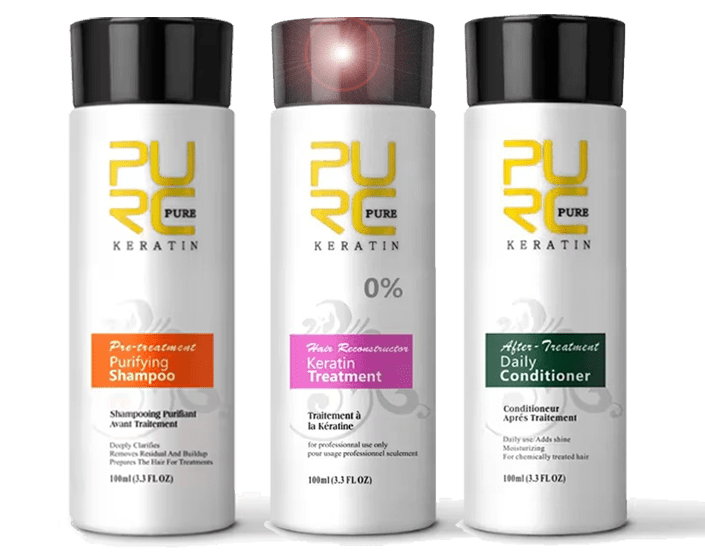
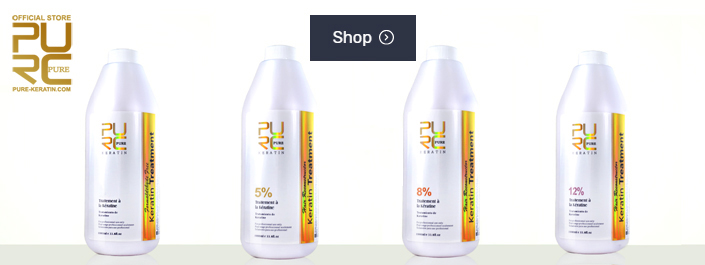
Choosing the correct formula and following the complete application instructions are essential. Pure Keratin offers treatments and hair-care products for different hair types and needs.
Haircut Before vs. After Keratin: The Simple Rule
If you are still unsure, remember this:
Remove what you definitely don't want before the treatment. Shape what you want to keep after the treatment.
That means:
- Badly damaged ends? Remove them if necessary.
- Removing 10 inches of length? Rough-cut first.
- Creating precise layers? Finalize them afterward.
- Cutting bangs? Usually finalize them afterward.
- Cleaning up the perimeter? After treatment is ideal.
- Creating a precise bob? Do the final shaping afterward.
Frequently Asked Questions
Should I cut my hair before or after a keratin treatment?
For most haircuts, it is better to perform the keratin treatment first and finalize the haircut afterward. This allows the stylist to shape your hair according to its smoother post-treatment texture, movement and volume.
Should I trim my hair before a keratin treatment?
A preliminary trim can make sense if you have severely split, broken or damaged ends. Otherwise, the final trim can usually be performed after the treatment so the stylist can work with the finished texture.
Should split ends be cut before or after keratin?
Severely split ends can be removed before the treatment. However, a final trim afterward can help create a cleaner, more precise finished shape. Keratin treatment should not be considered a permanent repair for physically split ends.
Can I get a haircut and keratin treatment on the same day?
Yes, in many cases. A stylist can perform the keratin treatment and then complete the final haircut during the same appointment. If a large amount of damaged or unwanted length needs removing, a preliminary cut may be performed first.
How long after a keratin treatment can I cut my hair?
A haircut can often be performed immediately after the keratin protocol is completed, including during the same salon appointment. Treatment formulas vary, so follow any specific post-treatment restrictions supplied with your product.
Can I cut my hair the day after keratin?
Generally, yes. Cutting the ends does not wash the keratin treatment out of the remaining hair. Continue to follow the washing and aftercare restrictions for your particular treatment.
Will cutting my hair after keratin remove the treatment?
No. Cutting removes only the portion of hair that is physically cut away. The keratin treatment remains on the hair that you keep.
Should I get layers before or after keratin treatment?
Layers are generally best finalized after the keratin treatment because smoothing can change the hair's apparent volume, movement and length. The stylist can position the layers more precisely once the finished texture is visible.
Should I cut bangs before or after keratin?
Bangs or fringe are usually better finalized after treatment. Hair around the face can sit flatter or appear longer after smoothing, so cutting beforehand can make it harder to predict the final length.
Should I get a bob before or after keratin?
For a precise bob, completing the final cut after keratin allows the stylist to create the perimeter based on the smoother finished texture. If a large amount of length is being removed, a rough cut can be done first.
Does hair look longer after a keratin treatment?
Curly or wavy hair can appear longer after a keratin smoothing treatment because reduced curl and shrinkage reveal more of the strand's existing length. The treatment does not cause the hair to grow during the service.
Should I color my hair before or after keratin?
Color and keratin involve a more formula-specific decision than a haircut. The correct sequence depends on the color process, whether bleach is involved, the keratin formula and hair condition. Follow both manufacturers' instructions or ask an experienced professional stylist.
Can I cut curly hair after a keratin treatment?
Yes. If you plan to wear your hair predominantly in its smoother post-treatment state, cutting afterward lets the stylist shape the hair around that result. If preserving a specific natural-curl haircut is important, discuss the plan with a curl specialist before treatment.
Final Answer: Cut Your Hair Before or After Keratin?
For most people, get the keratin treatment first and the final haircut afterward.
Keratin smoothing can change how the hair falls, how much volume it has and how long curly or wavy hair appears. Cutting afterward allows the stylist to shape the hair based on its actual finished texture.
There are two useful exceptions:
- Severely damaged or split ends: remove obviously compromised hair before treatment if necessary, then refine the haircut afterward.
- Major length removal: rough-cut unwanted length first so you do not waste treatment on hair you intend to remove, then perform the precision haircut afterward.
The simplest rule is: rough-cut before when necessary; precision-cut after for the finished shape.
Ready for Smoother, More Manageable Hair?
Start by choosing a professional keratin treatment suited to your hair, follow its application instructions carefully, and plan your final haircut around the smoother finished result.