


Keratin Treatment for Low-Porosity Hair | Pure Keratin
KERATIN TREATMENT on 24th Sep 2026
Updated September 24, 2026 | Pure Keratin Hair Care Guide
Keratin Treatment for Low-Porosity Hair: How to Smooth Frizz Without Weighing Hair Down
Yes, low-porosity hair can benefit from a keratin treatment. The key is not simply adding more keratin or more product. Low-porosity hair tends to resist water and treatments and can develop surface buildup more easily, so the best results usually come from careful preparation, even application, appropriate heat and lightweight aftercare.
If your hair is frizzy but products often leave it greasy, stiff, coated or flat, you may be dealing with a combination of low porosity, buildup and product overload. A properly selected keratin smoothing treatment can help reduce frizz and make styling easier without sacrificing all of your natural movement.
This guide explains how keratin treatments interact with low-porosity hair, how to recognize low porosity, what to do before treatment, how to avoid weighing the hair down, and how to maintain smooth results afterwards.
Is Keratin Treatment Good for Low-Porosity Hair?
A keratin treatment can be a good option for low-porosity hair when the goal is to reduce frizz, improve smoothness and make the hair easier to manage. Low porosity does not automatically mean that you should avoid every product containing keratin or protein.
What matters is the complete formula, the condition and thickness of your hair, the amount applied, how the treatment is processed, the heat used and what you apply to your hair afterwards.
Low-porosity hair has a relatively resistant outer surface. According to the New York Society of Cosmetic Chemists, it may take longer to wet and dry, products may accumulate on its surface more easily, and some protein treatments may leave it feeling stiff.
This is why a successful keratin treatment for low-porosity hair should focus on controlled smoothing rather than product saturation.
What Is Low-Porosity Hair?
Hair porosity describes how readily the hair takes up and interacts with water, hair products and chemical treatments. The outermost part of a hair fiber is the cuticle, which consists of overlapping cells that protect the inner portions of the strand.
With low-porosity hair, the cuticle structure is relatively resistant to water and chemical treatments. Instead of products appearing to disappear quickly into the hair, creams, oils, masks and styling products may seem to remain on the surface.
That can create a confusing combination:
- Your hair can feel dry yet become greasy from products very quickly.
- You can experience frizz even though rich conditioners make your hair flat.
- Your hair may take a long time to become fully wet in the shower.
- Heavy masks can leave your hair coated rather than soft.
- Repeated protein-rich products may leave the strands feeling stiff.
Porosity is not necessarily identical across your entire head. Hair that has been bleached, colored, exposed to heat or weathered at the ends can behave differently from newer growth near the scalp.
How Do You Know If Your Hair Is Low Porosity?
There is no perfect at-home test that can precisely measure hair porosity, but the way your hair behaves provides useful clues.
Common signs of low-porosity hair include:
- Water initially beads on the hair instead of soaking in quickly.
- Your hair takes time to become completely saturated in the shower.
- Your hair can take a long time to dry.
- Conditioners and styling products seem to sit on the surface.
- Rich products quickly make the hair feel greasy or heavy.
- Protein-rich products sometimes leave the hair feeling firm or stiff.
- Chemical services may process differently from what you expect.
- You experience buildup easily even though your hair can still feel frizzy.
What about the hair float test?
You may have seen a test that tells you to place a strand of hair in a glass of water and judge porosity by whether it floats or sinks.
Do not rely on that result alone. Surface oils, product residue, strand diameter and other variables can affect what happens in a glass of water.
For practical hair care, observing how quickly your hair gets wet, how products behave on it and how easily buildup develops is often more useful than assigning your entire head of hair a category based on one floating strand.
Keratin Treatment vs Protein Treatment: Are They the Same?
No. This distinction is especially important for people researching keratin for low-porosity hair.
A protein-containing conditioner or mask and a professional-style keratin smoothing treatment are not automatically interchangeable.
Hair itself is made largely from keratin proteins. Hair-care formulas can contain different types and sizes of hydrolyzed proteins, amino acids, conditioning ingredients, smoothing agents and other cosmetic ingredients. Their behavior depends on the complete formulation—not simply on whether the word “keratin” appears on the label.
A keratin smoothing treatment is generally designed to change the way the hair surface behaves so that the finished hair looks smoother, shinier and less frizzy and is easier to style.
This means the statement “low-porosity hair should never use keratin” is too broad to be useful.
A better question is:
Which smoothing formula, application amount and processing method are appropriate for the condition, density, diameter and history of my hair?
Potential Benefits of a Keratin Treatment for Low-Porosity Hair
When low-porosity hair is also frizzy, puffy or difficult to style, an appropriate keratin treatment can offer several cosmetic benefits.
1. Less visible frizz
Frizz is one of the main reasons people consider keratin smoothing. A well-performed treatment can create a smoother-looking surface and make flyaways easier to control.
2. Easier styling
Hair that normally requires extensive blow-drying and repeated passes with styling tools may become easier to manage after smoothing.
3. More polished shine
A smoother hair surface reflects light more evenly, which can make hair look glossier.
4. Less puffiness
Keratin smoothing can reduce unwanted expansion and help hair maintain a more polished shape in humid conditions.
5. Softer movement when the correct formula is used
The goal for low-porosity hair should not be to coat the hair with as much product as possible. The goal is an even smoothing result that still allows the hair to move naturally.
Why Does Low-Porosity Hair Get Weighed Down So Easily?
The biggest challenge with low-porosity hair is often not a lack of products. It is too much material accumulating on the surface of the strand.
Low-porosity hair may become heavy from combinations of:
- Silicone-rich styling products.
- Heavy oils and butters.
- Repeated masks.
- Dry shampoo.
- Leave-in conditioner.
- Styling creams.
- Mineral deposits from hard water.
- Incomplete rinsing.
- Repeated layering of protein-containing products.
Add a smoothing treatment on top of significant existing buildup and the finished hair may feel heavier than expected.
That is why preparation is particularly important for low-porosity hair.
How to Prepare Low-Porosity Hair Before a Keratin Treatment
Step 1: Start with an honest assessment of your hair
Look beyond porosity. Consider whether your hair is:
- Fine, medium or coarse.
- Natural or color-treated.
- Bleached or highlighted.
- Healthy or prone to breakage.
- Straight, wavy, curly or coily.
- Covered with styling-product buildup.
Two people can both have low-porosity hair and still require very different treatment approaches.
Step 2: Remove cosmetic buildup as directed
Keratin treatment protocols commonly begin with a cleansing or purifying step. This is especially relevant when low-porosity hair feels coated.
The purpose is to begin the treatment with clean hair rather than layering the smoothing formula over oils, conditioners, styling creams and residue.
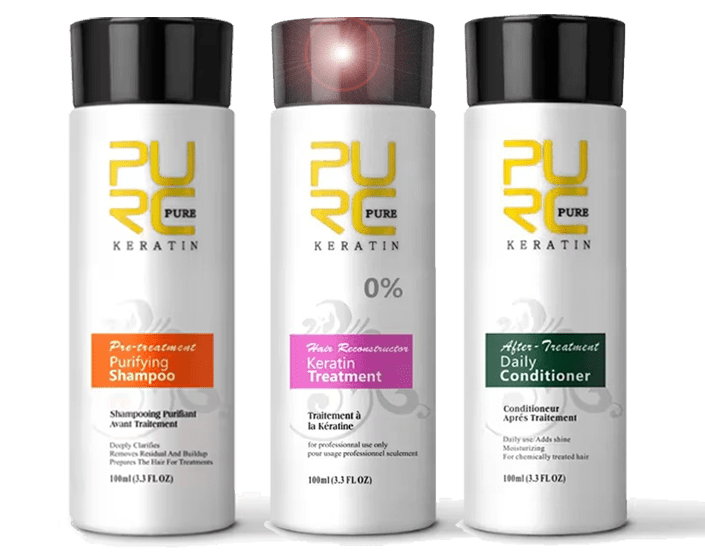
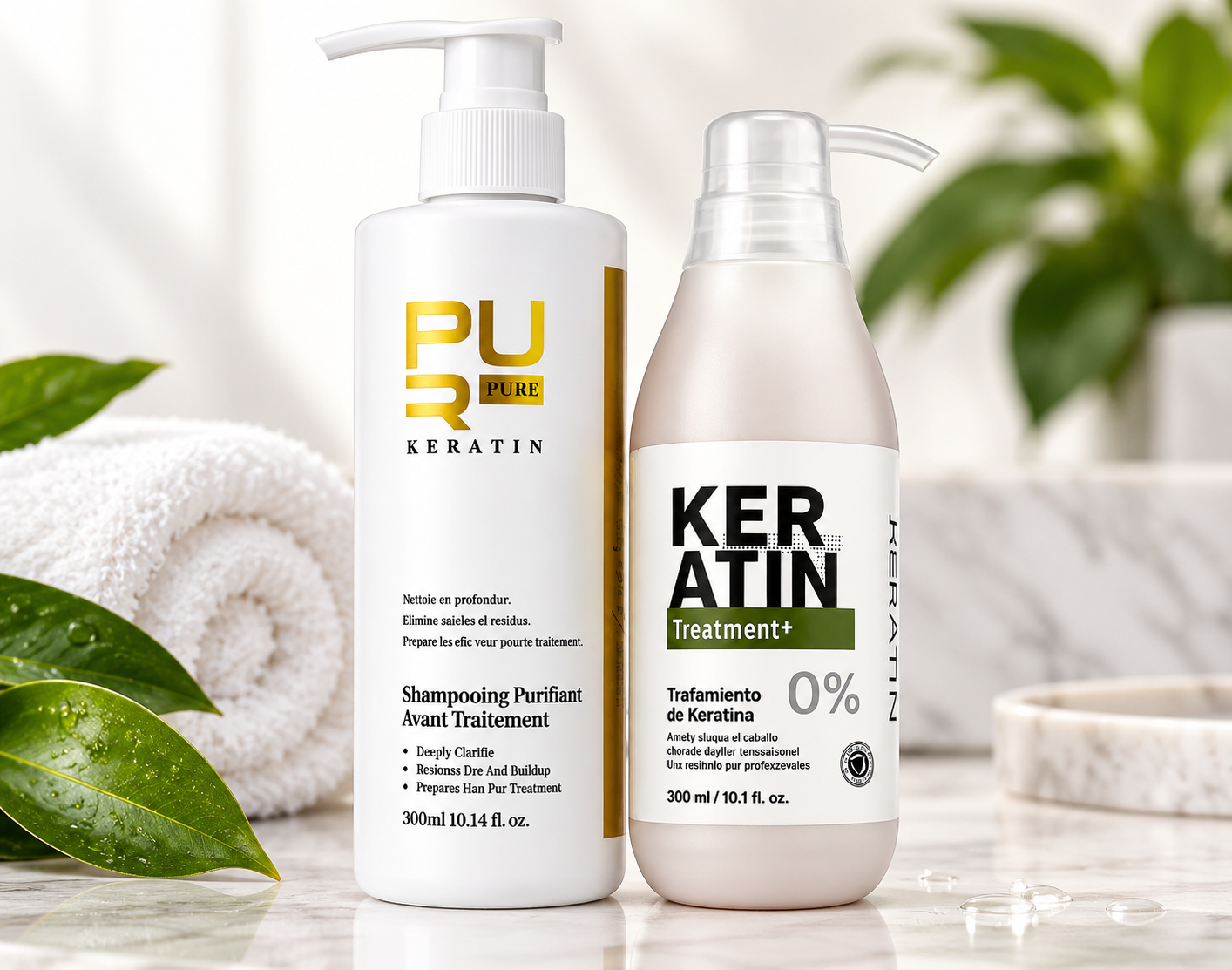
Pure Keratin offers a dedicated Keratin Purifying Shampoo for pre-treatment cleansing.
Follow the instructions supplied with your specific treatment. More aggressive cleansing is not automatically better, particularly if the hair is already fragile or highly processed.
Step 3: Do not load the hair with heavy products immediately before treatment
Avoid creating an unnecessary barrier of oils, masks and leave-ins directly before a treatment unless the product instructions specifically call for them.
Step 4: Consider a strand test
If your hair is bleached, very fine, fragile, previously straightened or chemically processed, testing a small section before treating the entire head can help reveal how the hair responds.
How Much Keratin Should You Apply to Low-Porosity Hair?
Enough to distribute the treatment evenly—but not so much that the hair is unnecessarily saturated with excess product.
This is one of the most important principles for low-porosity hair.
Using more treatment does not automatically create smoother or longer-lasting results. Excess formula can make already buildup-prone hair feel coated or heavy and may make blow-drying and heat processing more difficult.
A better application strategy:
- Divide the hair into manageable sections.
- Apply the treatment according to the manufacturer's directions.
- Distribute it consistently through each section.
- Comb through when the product instructions call for it.
- Avoid unnecessary oversaturation.
- Follow processing times exactly for the formula you are using.
Keratin treatments vary considerably, so the instructions supplied with the product should always take priority over a generic technique found online.
What Flat-Iron Temperature Should You Use on Low-Porosity Hair?
There is no single flat-iron temperature that is correct for every person with low-porosity hair.
Porosity is only one variable. Hair diameter, bleaching, coloring, previous chemical services, breakage and the specific keratin formula all matter.
Heat is an important part of many keratin smoothing protocols, but excessive thermal exposure can damage the hair fiber. Scientific studies of repeated hot-iron exposure have documented structural changes within hair, and dermatologists also recommend minimizing unnecessary high heat during routine styling.
For that reason:
- Follow the temperature range supplied with your specific keratin formula.
- Do not automatically choose the maximum temperature.
- Be more conservative with fine, bleached, highlighted or fragile hair.
- Use the number of passes specified by the treatment instructions.
- Do not repeatedly iron the hair simply because it is low porosity.
If you are unsure how much heat your hair can tolerate, professional application is the safer choice.
Keratin Treatment for Fine, Low-Porosity Hair
Fine, low-porosity hair requires particular attention to product weight.
Fine hair has a smaller strand diameter, while low-porosity hair can already be prone to surface buildup. Together, those characteristics mean that an overly rich routine can quickly leave hair looking flat.
The objective should be to reduce frizz while preserving natural movement.
For fine, low-porosity hair:
- Choose a formula appropriate for fine or delicate strands.
- Do not oversaturate the hair with treatment.
- Be cautious with excessive heat.
- Keep post-treatment styling products lightweight.
- Avoid layering several rich masks, oils and leave-ins at once.
- Judge products by how your hair responds rather than by how rich the formula sounds.
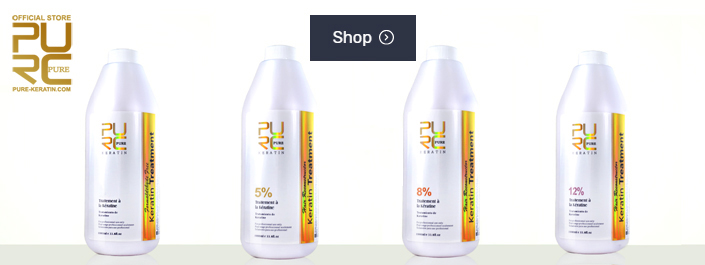
Pure Keratin has a dedicated 0.0% Keratin Treatment for Thin Hair for people whose low-porosity hair is also fine or delicate.
Porosity alone does not determine which treatment strength you need, so always consider the complete condition and history of your hair.
For more help with this combination, read our guide to the best keratin treatment for frizzy fine hair.
What About Curly, Low-Porosity Hair?
Low porosity and curly hair can absolutely occur together.
If you have curls, the most important question is not simply whether keratin is suitable. It is how much curl reduction you actually want.
Some people want maximum straightening. Others want to keep much of their wave or curl pattern while reducing frizz and shortening styling time.
Before treatment, decide whether your priority is:
- Maximum straightening.
- Frizz reduction.
- Softer curls.
- Less volume.
- More manageable styling.
- Smoother hair without eliminating all natural texture.
Those are different goals and may require different formulas and techniques.
If retaining body matters to you, see our guide to keratin treatments without losing volume.
Low-Porosity Hair, Keratin and Hard Water: A Hidden Buildup Problem
If your hair becomes coated easily, your styling products may not be the only source of buildup.
Hard water contains dissolved minerals, primarily calcium and magnesium. With repeated washing, mineral deposits can contribute to hair feeling dull, rough, heavy or difficult to condition.
That can be especially frustrating for someone with low-porosity hair because the symptoms can resemble ordinary product buildup:
- Hair feels coated.
- Shine decreases.
- Conditioner seems less effective.
- Hair feels heavier.
- Frizz seems to return.
If you repeatedly clarify your hair but the coated feeling returns, it may be worth checking the hardness of your water rather than simply using stronger shampoo more often.
Read our full guide: Does Hard Water Make Keratin Fade Faster?
Best Aftercare for Low-Porosity Hair After Keratin
Aftercare for low-porosity hair should protect your smoothing result without creating a new layer of buildup.
1. Follow the waiting period for your specific treatment
Some keratin formulas can be washed relatively quickly, while others specify a waiting period. Follow the directions for the exact product you used.
2. Cleanse often enough for your scalp and hair
Do not assume that low-porosity hair must go as long as possible without washing.
If your scalp is oily or styling products are building up, delaying cleansing can simply add more residue. Wash according to your scalp, lifestyle and treatment instructions.
For maintenance, explore the Pure Keratin After Keratin Treatment Daily Shampoo.
3. Condition without automatically choosing the heaviest product
Low-porosity hair still benefits from conditioning. The challenge is finding the amount and texture that leave the hair soft rather than coated.
Fine hair may only need conditioner through the mid-lengths and ends, while thicker or curlier hair may need more.
4. Add leave-in products gradually
If your hair feels good with one lightweight leave-in, there is no need to automatically add oil, cream, butter and serum on top of it.
5. Watch how your hair responds to additional protein
You do not need to fear every protein ingredient after a keratin treatment. However, if repeated protein-heavy products leave your hair progressively stiff, rough or difficult to style, simplify the routine and reassess.
6. Protect the hair from unnecessary heat
One advantage of smoother, easier-to-style hair is that you may need less daily heat. Take advantage of that whenever possible.
How Do You Know If Low-Porosity Hair Has Too Much Product?
Your hair may be overloaded if it begins to:
- Feel waxy or coated immediately after washing.
- Look greasy much sooner than usual.
- Lose movement and volume.
- Become unusually stiff.
- Feel dry even though you are applying more conditioner.
- Take longer to dry because of heavy product layering.
- Become difficult to style.
- Look dull despite using shine products.
If this happens, the answer is not necessarily to add another mask.
Consider simplifying the routine and determining whether the problem is product residue, mineral buildup, excessive protein layering, an unsuitable product combination or actual hair damage.
Low Porosity vs High Porosity: Does Keratin Application Change?
| Hair characteristic | Low-porosity hair | High-porosity hair |
|---|---|---|
| Water absorption | Often slower | Often faster |
| Product buildup | Can occur easily on the surface | Products may appear to absorb quickly |
| Hair surface | Relatively resistant | Often more weathered or damaged |
| Main keratin concern | Avoid unnecessary product overload | Avoid excessive stress on already compromised hair |
| Heat | Follow formula and hair-condition requirements | Extra caution may be needed if damage is present |
| Aftercare focus | Lightweight conditioning and buildup control | Conditioning, gentle handling and damage prevention |
This comparison also explains why the same treatment protocol should not automatically be used on every head of hair.
Best Keratin Routine for Low-Porosity Hair
For most people, the simplest approach is also the easiest to control:
- Identify whether buildup is present.
- Cleanse according to the keratin treatment instructions.
- Select a treatment appropriate for your strand diameter, condition and desired result.
- Apply evenly without unnecessary oversaturation.
- Follow the specified processing time.
- Use heat appropriate to the formula and condition of the hair.
- Follow the manufacturer's first-wash instructions.
- Keep everyday aftercare effective but lightweight.
- Watch for mineral and product buildup over time.
- Reduce unnecessary heat once your hair is easier to style.
Why Choose Pure Keratin for a Complete Keratin Routine?
Getting good results from a smoothing treatment requires more than the treatment bottle itself. Preparation, application and aftercare all influence how the finished hair looks and feels.
Pure-Keratin.com specializes in keratin smoothing and hair-care solutions and offers more than 200 hair-care products across treatment and maintenance routines, backed by more than 30 years of hair-care experience.
The range includes:
- Professional and at-home keratin treatments.
- Options for different hair types and treatment goals.
- Pre-treatment cleansing products.
- Post-keratin shampoos and conditioners.
- Masks and maintenance products.
- Accessible at-home options for customers who want to reduce the cost of repeated salon services.
For low-porosity hair, that variety matters because the best routine is not simply the strongest or richest product. It is the combination that matches your actual hair.
Explore Pure Keratin treatments and professional hair-care products →
Keratin Treatment Safety: What to Check Before You Start
Hair smoothing products are not all formulated in the same way.
The U.S. Food and Drug Administration advises consumers to read ingredient information and be aware that some hair-smoothing products can contain or release formaldehyde when heated.
Before using any smoothing system:
- Read the complete ingredient list.
- Follow the manufacturer's safety instructions.
- Use appropriate ventilation when instructed.
- Avoid contact with the eyes and irritated skin.
- Do not exceed specified processing times or temperatures.
- Seek professional advice for severely damaged or chemically compromised hair.
If you experience burning, breathing difficulty, strong irritation or another unexpected reaction, stop the service and seek appropriate medical advice.
Frequently Asked Questions About Keratin Treatment for Low-Porosity Hair
Can you do a keratin treatment on low-porosity hair?
Yes. Low-porosity hair can receive a keratin smoothing treatment. The key is selecting a formula appropriate for the hair's condition and diameter, preparing the hair properly, avoiding excessive product and using heat according to the treatment instructions.
Is keratin bad for low-porosity hair?
Keratin is not automatically bad for low-porosity hair. Some low-porosity hair becomes stiff with repeated protein-rich products, but a keratin smoothing treatment is not identical to using a protein mask. The overall formula, application technique and condition of your hair matter.
Can keratin help low-porosity frizzy hair?
Yes. Keratin smoothing can help reduce visible frizz and make low-porosity hair easier to style. The best result is smooth, manageable hair without unnecessary heaviness or product buildup.
Why is my low-porosity hair frizzy if the cuticle is resistant?
Low porosity does not mean hair can never become frizzy. Texture, weather, styling habits, mechanical damage, hair diameter, uneven porosity and buildup can all affect the way your hair looks and behaves.
Will a keratin treatment make low-porosity hair flat?
It can reduce volume, but flatness is not inevitable. The result depends on the treatment strength, application amount, technique, natural texture and hair diameter. Fine, low-porosity hair generally needs particular care to avoid unnecessary weight.
Should I clarify low-porosity hair before keratin?
Many keratin protocols specify a purifying or clarifying wash before treatment to remove oils and cosmetic buildup. Follow the cleansing instructions included with the exact product you use rather than repeatedly clarifying on your own.
Does low-porosity hair need more keratin product?
No. Resistance to water or products does not mean you should compensate by oversaturating the hair. Apply enough treatment to achieve even distribution according to the manufacturer's directions. More product does not automatically mean better results.
What is the best keratin treatment for fine low-porosity hair?
Fine, low-porosity hair generally benefits from a smoothing formula designed with delicate strands in mind and from careful application that avoids excessive weight. Pure Keratin offers a dedicated 0.0% treatment for thin hair that may be suitable when low porosity is combined with fine hair.
Can low-porosity hair have too much protein?
Some people with low-porosity hair notice increased stiffness when they repeatedly use protein-rich treatments. If your hair becomes progressively rigid or rough, simplify your routine and reassess the products you are layering rather than automatically adding more protein or moisture.
How often should low-porosity hair be washed after keratin?
There is no universal washing schedule for all low-porosity hair. Follow the initial waiting period specified by your treatment, then wash according to your scalp needs, lifestyle and the products you use. Allowing heavy buildup to accumulate is not beneficial simply because the hair is low porosity.
Is low-porosity hair always healthy hair?
No. Porosity describes how the hair interacts with water and treatments; it is not a complete measurement of hair health. A person can have low-porosity hair and still experience breakage, heat damage, scalp problems or other hair-care concerns.
Can different parts of my hair have different porosity?
Yes. Porosity can vary across the head and along an individual strand. Older ends that have experienced coloring, bleaching, UV exposure, friction and heat may behave differently from newer hair near the roots.
Keratin Treatment for Low-Porosity Hair: The Bottom Line
Low-porosity hair does not automatically need to avoid keratin treatments.
The real challenge is achieving the smoothing benefits of keratin without creating unnecessary heaviness, stiffness or buildup.
For the best result:
- Confirm that your hair actually behaves like low-porosity hair.
- Consider strand diameter, chemical history and damage—not porosity alone.
- Remove existing buildup according to your treatment protocol.
- Do not assume more product creates a better result.
- Use the processing time and heat specified for your chosen formula.
- Be especially careful with fine, bleached or fragile hair.
- Keep aftercare lightweight enough to prevent surface buildup.
- Investigate hard water if your hair repeatedly feels coated.
When those variables are controlled, a keratin treatment can help low-porosity, frizz-prone hair look smoother, shinier and easier to manage while maintaining natural-looking movement.
Scientific and Professional Sources
This guide is based on established hair-fiber science, professional cosmetic-chemistry resources and current hair-care safety guidance.
- New York Society of Cosmetic Chemists — An Overview on Hair Porosity
- International Journal of Cosmetic Science / PubMed — Cuticle: Designed by Nature for the Sake of the Hair
- PubMed Central — Thermal Induced Changes in Cuticle and Cortex to Chemically Treated Hair
- Journal of Cosmetic Science / PubMed — Effects of Hot-Iron Setting on the Hair Fiber
- American Academy of Dermatology — Tips for Healthy Hair
- U.S. Food and Drug Administration — Hair Smoothing Products That Release Formaldehyde When Heated